Uncategorized

News That Traders Can Use

Toshiba Considering Options for Selling Its Chip Unit

Toshiba Corp. investors approved the sale of its memory chip unit and backed the appointment of new board members over the objections of proxy advisers. Toshiba hopes to complete the sale of the chip unit by March, helping the company avert a capital deficit that could lead to its delisting.

The deal is being challenged by manufacturing partner Western Digital Corp. (NYSE: WDC) and still needs to receive regulatory approval. Toshiba is considering alternative options in case the sale doesn’t close according to company officials.

Source: Bloomberg

Why this matters to traders: This deal has weighed on shares of WDC this year. The chart below shows that WDC has been in a trading range.
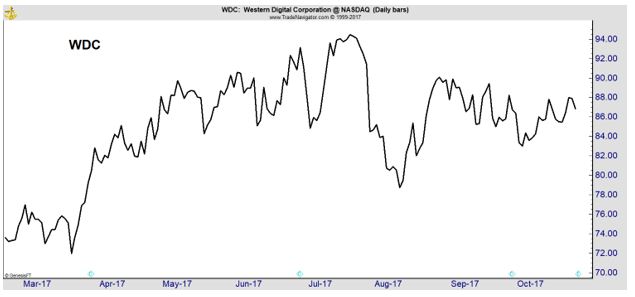
WDC also offers value. The stock trades at less than 8 times this year’s expected earnings and could move sharply higher when this issue is resolved.

Tesla to build factory in China

Electric-car maker Tesla Inc. (Nasdaq: TSLA)  reaffirmed that it was speaking with the Shanghai municipal government to set up a factory in the region and expected to agree on a plan by the end of the year, but it declined to comment on a report that a deal had been reached.

China levies a 25% duty on sales of imported vehicles and has not allowed foreign automakers to establish wholly owned factories in the country, the world’s largest auto market. Those are problems for Tesla, which wants to expand its presence in China’s growing market.

Source: BusinessInsider

Why this matters to traders: TSLA’s success could depend on China which is moving quickly to eliminate gas-powered vehicles. The stock needs a catalyst to break out of its trading range.
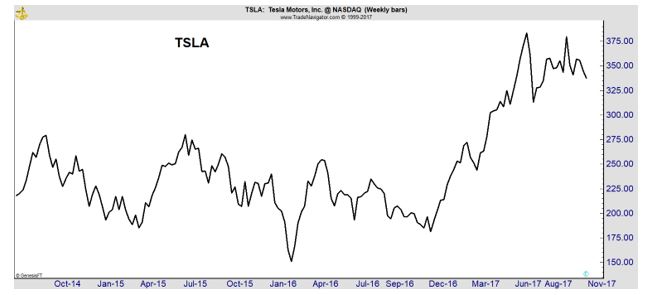
News from China could provide that catalyst, up or down. For now, it looks like a downside break is possible and TSLA could deliver quick gains for traders after a breakout.

Sprint’s quarterly loss narrower than estimated; merger expected

Sprint Corp (NYSE: S) reported a narrower loss than analysts estimated as it added subscribers, and the wireless carrier declined to hold a post-earnings conference call amid expectations of a merger with rival T-Mobile US Inc (Nasdaq: TMUS).

Sources told Reuters this week that T-Mobile and Sprint were laying the groundwork for special committees of their boards of directors to decide on a merger between the third and fourth largest U.S. wireless carriers.

Sprint and T-Mobile are expected to announce an agreement in the first half of November to create a company with more than 130 million U.S. subscribers, just behind Verizon Communications Inc and AT&T Inc.

Source: Reuters

Why this matters to traders: This deal has been discussed for months. If it happens, there could be a big move in the stocks. For now, TMUS has the more bullish chart pattern and could be the best choice for traders.
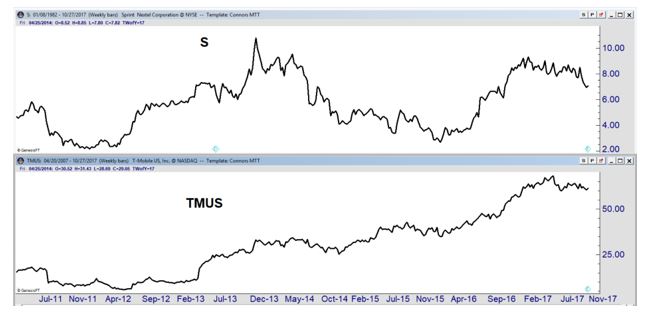
This may be a surprise given that rumors indicate S will be bought at a premium. The chart shows strength in TMUS and the possibility the premium may not materialize.

Walgreens beats Street 4Q forecasts

A drawn-out acquisition bid dented Walgreens’ fourth-quarter profit, but the nation’s largest drugstore chain topped expectations and it introduced a 2018 forecast that exceeds analyst predictions.

Walgreens Boots Alliance (Nasdaq: WBA) blamed termination fees and costs related to its pursuit of rival Rite Aid Corp. for a 22-percent drop in fiscal fourth quarter earnings, which fell to $802 million from $1.03 billion.

The company first announced a plan to buy Rite Aid in 2015, but regulators were reluctant to embrace a combination of the nation’s largest and third-largest drugstore chains, and the $9.4 billion bid languished for more than a year before Walgreens ended it in June. The company agreed to pay a $325 million termination fee to Rite Aid and another $25 million to Fred’s Pharmacy after it also ended a related deal.

Source: Associated Press

Why this matters to traders: Walgreens’ stock price has stalled as investors awaited completion of the Rita Aid Deal.
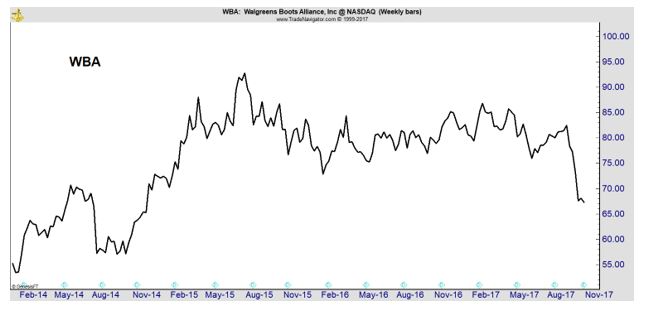
This earnings report and the strong guidance for 2018 could be an indicator the company is focused on the business it has rather than acquisitions. That could be bullish for the stock.

McDonald’s Rolls Out Successor to Dollar Menu

McDonald’s Corp. (NYSE: MCD), the world’s largest restaurant chain, facing heavy competition in the U.S., will launch a new value-priced menu nationally next year. The lineup will offer items for $1, $2 and $3, the company said on Tuesday.

The rollout will provide a long-awaited replacement to the Dollar Menu, which was popular with customers but less so with McDonald’s franchisees. The company has experimented with various discounts — including McPick 2 for $5, which let customers choose two items — in a bid to find something that wasn’t too hard on the profit margins of restaurant operators.

Source: Bloomberg

Why this matters to traders: This news comes on the heels of a better than expected earnings report and indicates McDonald’s management remains focused on providing the low cost meals that seem to be important to its customers.

This should allow the stock to continue climbing higher assuming the menu is well received by customers.
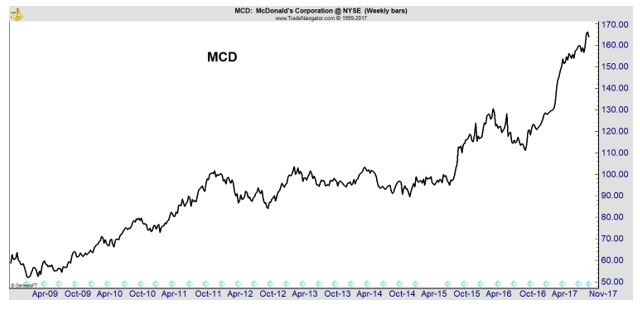
After a 48% gain in the past year, the stock could pull back but traders could use any weakness as an opportunity to build a long term position in the fast food giant.

China congress: No heir apparent as Xi reveals top leadership

China has revealed its new senior leadership committee, breaking with tradition by not including a clear successor to President Xi Jinping.

The omission cements Mr Xi’s grip on leadership for the next five years, a day after his name and his teachings were written into the constitution. But it raises questions over whether Mr Xi, 64, intends to rule beyond 2022.

Source: BBC

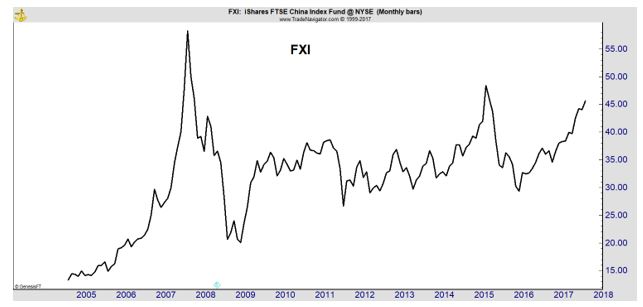
Why this matters to traders: Xi’s position is now secure and his policies seem likely to be maintained even after he leaves his leadership role. This indicates China could continue to grow as it has under Xi. That should be bullish for stocks.

Investors looking to China should consider ETFs like iShares FTSE China Index Fund (NYSE: FXI) which appears to be breaking out of a multiyear trading range.
Japan’s Shinzo Abe hails landslide victory in snap election

Japanese Prime Minister Shinzo Abe’s ruling coalition won a clear majority with more than two-thirds of Parliament’s 465 seats. His Liberal Democratic Party now holds a majority even without its coalition partner.

“We were able to earn the powerful support of the Japanese people, well surpassing our goal,” Abe said at a press conference after Sunday’s vote.

The win puts him on course to be post-war Japan’s longest-ever serving prime minister, and Abe is expected to use his new mandate to push for overhauls to the country’s defense strategy and pacifist stance.

Source: CNN

Why this matters to traders: Japanese stocks are trading at 21-year highs. This is shown below in the chart of the benchmark Nikkei 225 Index.
Article

You Probably Can’t Invest In the Best Performing Hedge Funds are Minimum Investment, But That’s Okay

Best Performing Hedge Funds are Minimum mysterious Investment for many investors. They are open to select investors, those who meet the legal requirements as accredited investors, can meet minimum investment amounts that can top $5 million at the best fund and agree to lock up periods that can run for years

If you qualify to invest in the fund, you will then pay for the privilege. Many fund managers charge a management fee of 2% a year and then take 20% of the profits. This incentive fee can be structured in different ways and might not be as bad as it sounds.

Most funds only charge the incentive fee when they are making new highs. If a fund loses 10% in a year, for example, they would need to recover those losses before they could take a percentage of the profits.

Other funds only take a share of the profits that exceed a benchmark. If a fund, for example, gained 30% in a year when the S&P gained 5%, the manager would make 20% on the 25% of gains that beat the benchmark.

The largest funds and those with the best track records could take even more in fees. One fund manager, Renaissance Technologies, is rumored to charge 5% in annual management fees and an incentive fee of more than 40%. But, the fund is closed to new investors.

Performance Drives the Fees

Accredited investors are sophisticated investors. The meaning of this phrase is defined by the Securities and Exchange Commission which says, “An accredited investor, in the context of a natural person,

includes anyone who:

  • earned income that exceeded $200,000 (or $300,000 together with a spouse) in each of the prior two years, and reasonably expects the same for the current year,

OR

  • has a net worth over $1 million, either alone or together with a spouse (excluding the value of the person’s primary residence).”

Based on these tests, it’s reasonable to assume that accredited investors have access to good financial planning advice. While individual investors avoid funds with high expenses, these investors are at times encouraged to pay the high fees.

One reason to pay so much is for performance

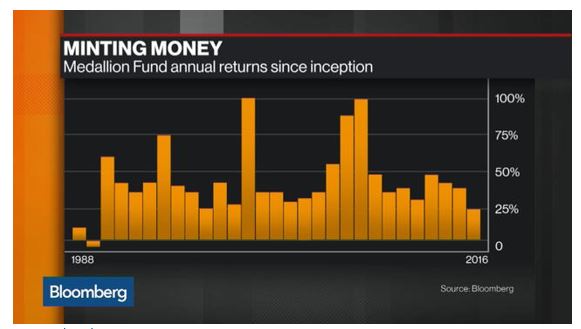
According to Bloomberg, the fund “has become probably the world’s most successful money machine. According to Bloomberg, the fund “has become probably the world’s most successful money machine. Powered by millions of lines of computer code, it has made about $55 billion over the past 29 years, thanks to average returns after fees of an astounding 40 percent.”


Source: Bloomberg


A $1,000 investment in the fund at inception would be worth more than $13.8 million at that rate of return.

Not all hedge funds perform like Medallion but investors in this arena are always looking for the next great fund.

Defining a Hedge Fund

A hedge fund is considered an alternative investment that is beyond the typical investment categories of stocks, bonds, real estate and collectibles. Hedge funds can often investment in anything and they often use leverage in an effort to boost returns.

The name comes from the first funds that were formed in the late 1940s. These funds were designed to decrease the risk in holding long term stock positions by selling short stocks the managers believed were set for a decline.

Early funds, in other words, hedged the risk of the stock market by seeking to benefit from declines. They also used leverage, or borrowed money, to increase the potential returns of the funds. The early funds generally performed well in a difficult market environment.

Their success, as almost all success on Wall Street does, led to imitation and competition. Many other managers rushed into the field and they added strategies. Soon funds were available to their select group of investors offering a variety of objectives:

  • Traditional hedged equity funds buy stocks they expect to outperform and short stocks expected to decline in value. This strategy is also known as a long/short strategy.
  • Market neutral hedge funds use stocks to create a portfolio that is expected to deliver returns with little volatility. These strategies often use Treasury bills as their benchmark and target returns that are slightly better than that
  • Arbitrage funds use different securities in different markets that are expected to converge to a similar value. Through a series of long and short trades the managers seek to capture short term pricing differences in different securities or in different markets
  • Distressed investment funds are looking for companies that could fall into bankruptcy. They then use their professional and legal teams to deliver profits on those securities.
  • Global macro funds look for trends driven by major news events and may invest in stocks, bonds, currencies, futures or any other investment they believe will benefit from that trend.

There are also fund of funds, or FOF, in the hedge fund world that invest in a number of other hedge funds. A FOF may invest in dozens of funds to provide diversified investments to hedge fund investors. This is useful since the minimum investments can be high and the best funds may be closed to new investors.

Accessing Hedge Funds If You Aren’t an Accredited Investor

As with any investment management activity, indexes have been developed to track the performance of hedge funds. The introduction of indexes has helped make hedge fund investments available to individual investors.

Exchange trades notes (ETNs) tracking hedge fund indexes are traded like the more common exchange traded funds (ETFs). The difference between the two is that ETFs will use the assets under management to buy shares of individual stocks while ETNs will use funds to buy derivatives. They both trade the same way.

The IQ Hedge Multi-Strategy Index Fund (NYSE: QAI) is an ETF designed to replicate the risk-adjusted return characteristics of hedge funds using multiple hedge fund investment styles, including long/short equity, global macro, market neutral, event-driven, fixed income arbitrage, and emerging markets.

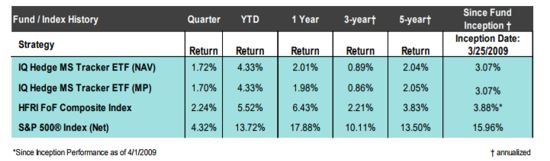
Unlike many hedge funds, individual investors can invest in QAI. The fund has more than $1 billion in assets. Its performance relative to benchmark indexes is shown in the table below.


Source: Fund Fact Sheet


This fund has underperformed the S&P 500 index since its inception on April 1, 2009. The industry standard benchmark, the HFRI FoF Composite Index, has also trailed the S&P 500 over that same time. This is actually not unexpected.

In a strong bull market like the one we have seen since March 2009, active managers are at a disadvantage. Their fees and costs contribute to underperformance as does their investment style. Active funds will seek to manage risks and in a strong bull market their defensive actions will hurt performance.

That’s why many investment managers urge investors to consider performance over a full market cycle which includes one full bull market and one full bear market. In the past two bear markets, the HFRI FoF Composite Index outperformed the stock market averages.

Between 2000 and 2002 as the stock market dropped by almost 50% as many stocks did far worse, the index delivered a gain. The index gained more than 20%. In the bear market that ended in 2009, the index declined less than half as much as the broad stock market averages.

This performance shows the value of a FoF in a portfolio. This is why large investors and institutions have owned hedge funds even through extended periods of underperformance. That is why we sought to introduce you to hedge funds in this article.

However, in future articles we will be highlighting alternative investment opportunities that have delivered strong performance.